
PDR & hail repair
Built for dent counts, matrices and storm volume
Hail work is a different business from collision. The pricing is a matrix, the documentation is the product, and the volume arrives all at once. FastFlow was built with that on the whiteboard — one record per vehicle, from check-in through the adjuster’s evidence link to the final bill.
A storm does not wait for your paperwork
Two hundred vehicles arrive in three weeks. Every one needs damage graded panel by panel, priced against whichever carrier is paying, documented well enough to survive review, and tracked through technicians who may have arrived with the storm. The bottleneck is almost never the repair. It is the documentation, the re-typing, and finding out on Friday which cars never moved.
What carries the weight
The workflows a hail operation depends on
Dent counts by panel and coin size
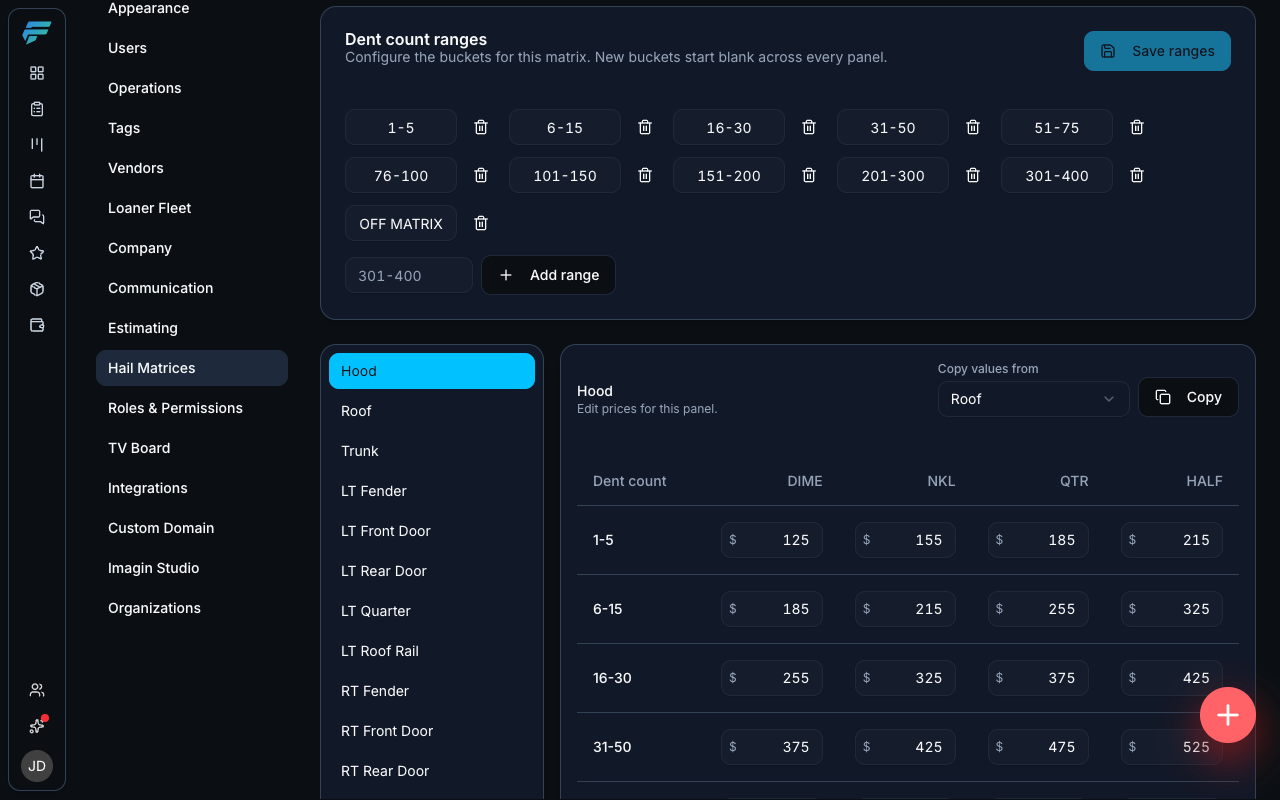
Grade each panel across eleven count ranges and the four coin sizes — dime, nickel, quarter, half dollar — in the terminology adjusters already recognize. Panel ceilings are enforced, and a count cannot be saved without a size, so nothing reaches review half-graded.
A price matrix per carrier
Keep one matrix per carrier plus your retail rates. The estimator picks which matrix a job is priced against, and the surcharges applied are frozen onto the line — so an estimate written six weeks ago still shows exactly what it was priced with.
Panels the matrix does not cover
An oversized panel or an unusual count does not stall the estimate. Price it by dollar amount or by repair hours and keep the vehicle moving.
Evidence that survives review
Circle each dent on the photo and tag it with panel and size drawn from your own matrix, so the annotation and the price speak the same language. Share the marked-up set with the adjuster and the clean originals with the customer — and see when the link was opened.
Aluminum flagged automatically
Marking a panel as aluminum raises its PDR figure automatically, so harder metal is never quoted at steel rates.
Technicians tracked per item
Assign each service item to the technicians who worked it, with their commission split. FastFlow blocks any edit that would reduce compensation already paid out — which matters most with storm crews who move on.
What changes for the shop
- Graded once
- Panel, count and size are recorded on the vehicle and carried into the estimate without re-typing.
- Priced by carrier
- The matrix the job was priced against, and the surcharges applied, stay attached to the estimate.
- Documented for review
- Annotated evidence for the adjuster, clean originals for the customer, one link for both.
- Tracked at volume
- Two hundred vehicles on one board, with the stalled ones raising themselves.
In practice
A hail vehicle, start to finish
- 1
The vehicle checks in against a thirty-six point inspection; anything marked not OK must be photographed.
- 2
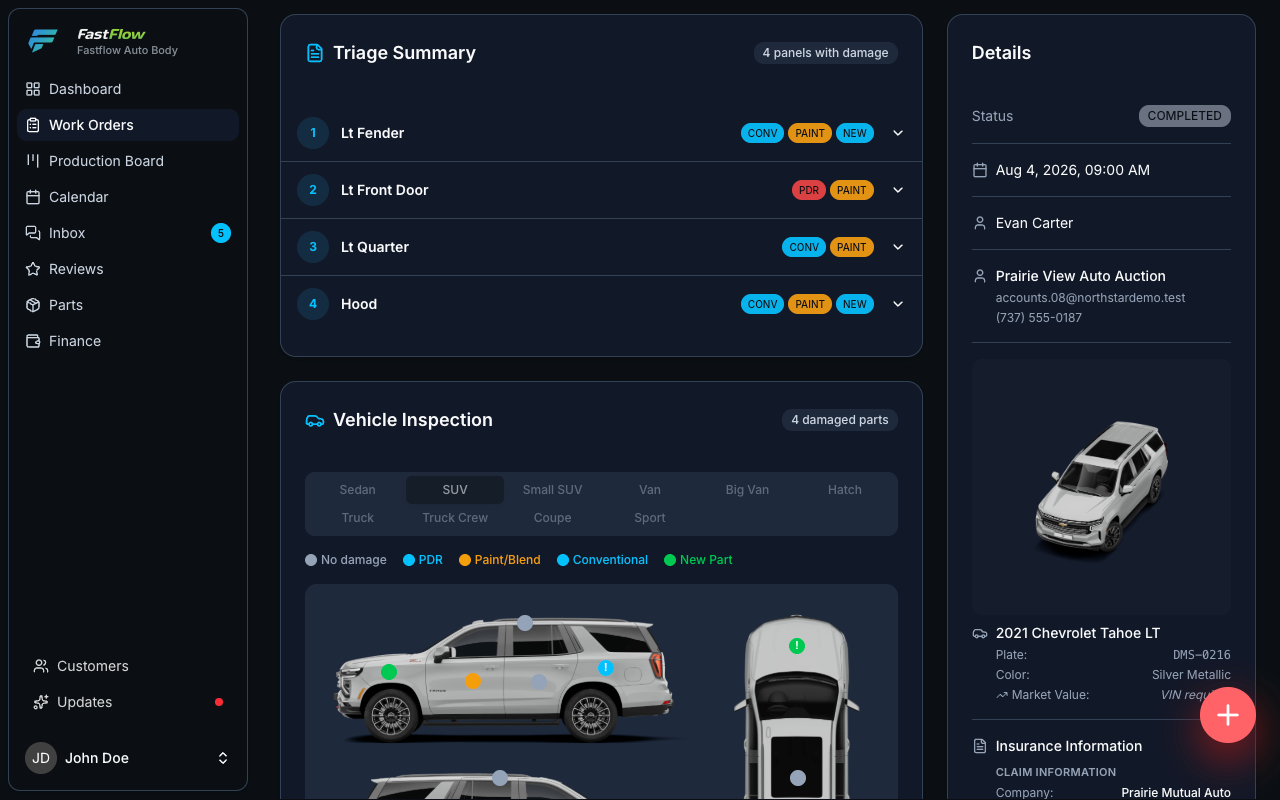
Damage is graded on the vehicle diagram — panel, count range, coin size, aluminum where it applies.
- 3
The estimate prices from the carrier’s matrix; two oversized panels are priced by repair hours instead.
- 4
The customer approves from their phone with a drawn signature and proposes a drop-off time.
- 5
The adjuster gets one link: annotated dents, full-resolution photos, ZIP download — and you can see when it was opened.
- 6
A supplement is raised mid-repair and escalates on the shop-floor board once it has waited too long.
- 7
The final bill splits the deductible from the carrier’s share, and any waived portion is recorded as forgone revenue with its reason.
See it running on your own numbers
30 minutes, screen shared: your workflow inside FastFlow, from intake to final payment. No slide deck.