
Finance
Accounting you can audit, on a screen you can read
The money side of the shop runs on the same records as the repair side. Double-entry underneath, balanced to the cent, where a correction is a visible reversal rather than a quiet edit — and on top of it, the handful of numbers an owner actually asks for.
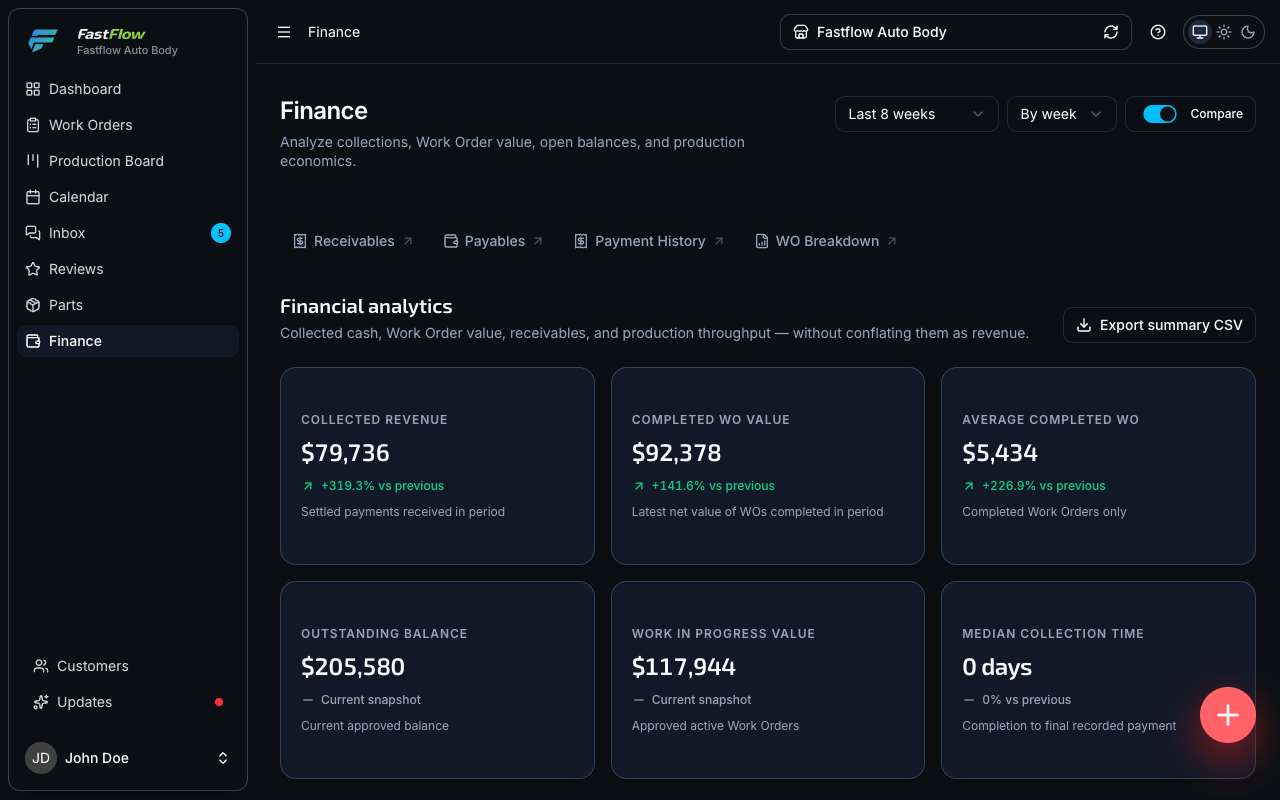
Three levels of certainty
Not all revenue is revenue
Most systems add it all together and call it revenue. That is how a shop convinces itself it had a good month on the strength of estimates nobody approved — and then wonders why payroll is tight.
Money that has actually arrived and posted. This is the number that pays wages, rent and the parts bill.
Work approved and delivered, invoice outstanding. Owed to you, but not yet money you can spend.
Estimates and supplements nobody has said yes to. A real possibility, and not revenue until somebody agrees.
Three equal-length bars stacked from most to least certain: Collected is solid, Confirmed receivable is part-filled, and Pending approval is an empty dashed outline.
- Collected Banked
Payment received and posted. This is the money that pays the bills.
- Confirmed receivable Owed
Work approved and delivered, invoice outstanding. Real, but not yours yet.
- Pending approval Possible
Estimates and supplements nobody has said yes to. Pipeline, not revenue.
Add the three together and you get the number that makes a bad month look survivable. Keep them apart and you know which one you can actually spend.
Then it tells you how overdue the middle one is
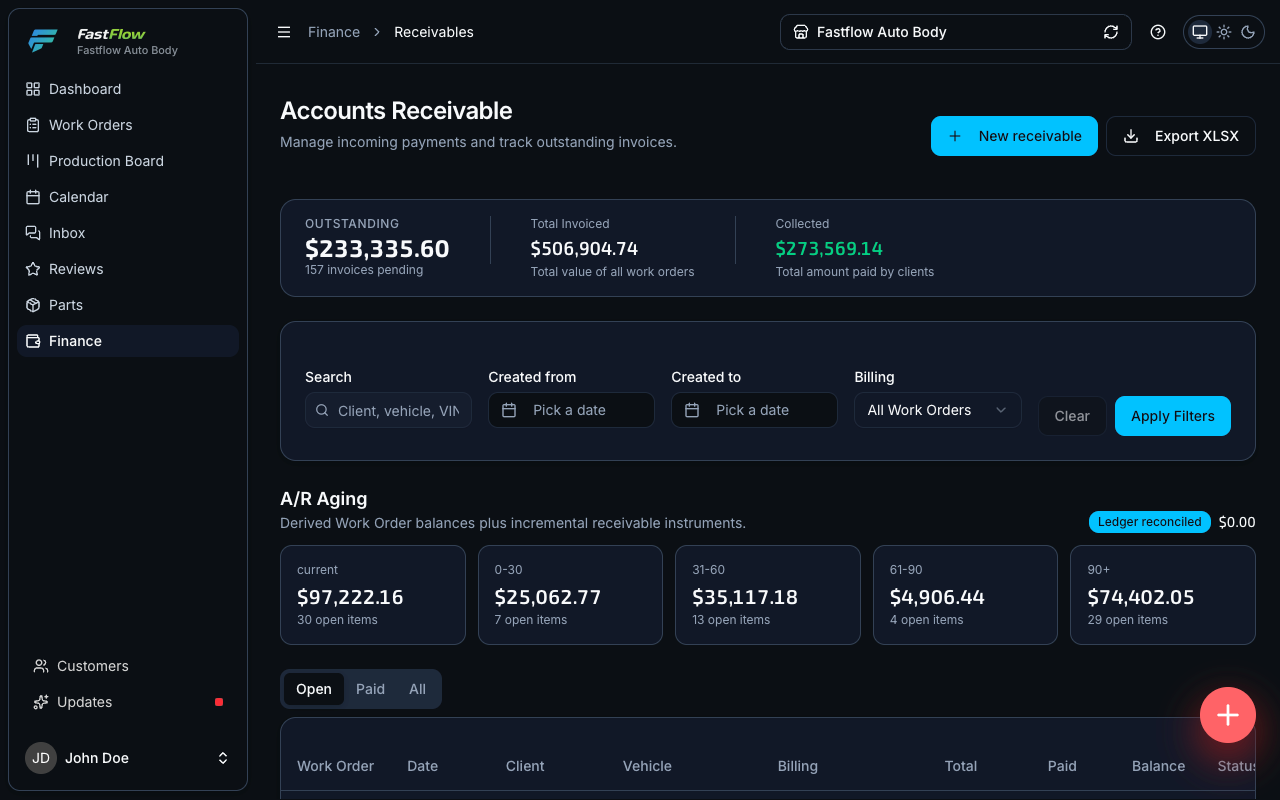
Confirmed receivable is not one number either. Receivables are broken across five aging buckets, so a balance sitting four months out never hides inside the same total as one invoiced last week.
The receivables screen also checks its own total against the ledger and shows the variance if the two ever disagree — because a collections list you have to double-check is a collections list nobody works.
How long it takes you to get paidBusiness customers
One invoice across twelve vehicles, one payment across all of them
Fleet and dealer accounts do not want a repair order per vehicle. They want one bill for the month — and your office does not want to reconcile one payment against thirty balances by hand.
Consolidated invoices
Roll finished work orders onto one numbered invoice, with draft, issued, partially paid and paid states, and a void that requires a reason. Work order balances stay the source of truth, so the consolidated invoice never becomes a second version of the debt.
Payments that allocate themselves
Apply one customer payment across multiple work orders — oldest first, proportionally, or exactly how you decide. If it was applied wrongly, reverse it; the ledger keeps both entries.
Statements
Opening balance, every movement in the period, closing balance and aging — pulling together consolidated invoices, loose work orders and standalone charges into the one document that settles a month-end disagreement.
Discipline
Discounts do not evaporate
A discount you cannot see is a discount you keep giving. Every waived deductible, goodwill gesture and write-off is recorded as forgone revenue with a reason attached — so at the end of the quarter you can say exactly how much you gave away, to whom, and why.
This is the difference between a job that was unprofitable and a job that was priced correctly and then discounted at the counter. Both look identical in a system that only records what was finally charged.
Immutable ledger
A transaction is balanced to the cent or it is refused. Corrections are made by reversal, so the history is what actually happened rather than the latest edit to it.
Reconciliation you can see
The receivables screen checks its own total against the ledger and shows the variance if the two ever disagree, instead of quietly presenting a number nobody can tie out.
Commissions that respect what is paid
Each technician has a running statement of what they earned, what has been paid and what is still pending. FastFlow blocks any edit that would reduce compensation already paid out.
Every finance capability, in full
Final bills, payments, receivables, consolidated invoicing, statements, payables, commissions and the ledger underneath all of it.
-
Final bill
Adjust the customer-facing closeout invoice — discounts, betterment, who pays what — without touching the underlying work order numbers the technicians are paid from.
-
Payments and payment history
Log every payment against its work order with method and reference, and see one chronological list of all money received.
-
Accounts receivable with aging
Which jobs still owe money and how overdue each one is, across five aging buckets — with a live check that the total matches the ledger, so the number you chase is the number that is true.
-
Standalone invoices and receipts
Issue a numbered invoice outside the normal job flow — a deductible, a toll, a supplement — and hand over a PDF invoice and receipt.
-
Consolidated invoices
Bill a fleet or dealer customer once for many finished vehicles, then apply their one payment across those work orders — oldest first, proportionally, or exactly how you decide.
-
Customer statements
With limitsOne period statement of everything a business customer owes, with opening balance, all activity, and aging.
Statements and invoices are generated as PDFs to download and send yourself. FastFlow does not email them for you.
-
Accounts payable and vendors
Track supplier bills and technician payouts, then pay one lump sum and have it applied across the oldest outstanding bills — with a preview before anything is committed.
-
Double-entry ledger
Every transaction is balanced to the cent and permanently recorded. Mistakes are corrected by a visible reversal rather than a quiet edit, so the history can always be audited.
-
Forgone revenue tracking
Every discount, goodwill gesture, waived deductible and write-off is recorded with a reason — so what you gave away shows up in profitability instead of quietly disappearing from it.
-
Collect or waive the deductible
Decide per job whether the deductible is collected or waived. A waiver is recorded as forgone revenue with its reason, not written off into thin air.
-
Technician commission ledgers
Each technician has their own running statement of what they earned, what has been paid, and what is still pending approval — so payday is not a spreadsheet argument.
-
Per-job profitability
With limitsRevenue, expenses, net profit and margin for a single job, after sales-side costs like rentals and sublet.
The sales breakdown is a profitability and commission worksheet. It does not post to the double-entry ledger.
-
Spreadsheet export
Export the exact filtered list on screen — every row, not just the current page — as a formatted workbook for your accountant.
-
Documents on your letterhead
Invoices, statements and estimates come out with your logo, address, tax IDs and payment instructions.
Bring us your messiest month
A fleet account, a waived deductible, a supplement approved late, one payment against nine jobs. 30 minutes, screen shared, and we show you where each one lands.